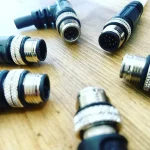
When there’s no room for an M12, an M8 cable is what goes in. M8 connectors fit on the small sensors, compact actuators, and tight robot arms where a larger connector won’t clear the housing. Technical Cable Applications (TCA) builds custom M8 cable assemblies at our main facility in Auburn, Washington, and at two nearshore partner facilities in Guadalajara, Mexico, to your pinout, length, jacket, and termination. We handle prototypes, production runs, and everything in between.
If you have a drawing, a part number to cross-reference, or a rough sketch, send it over. Request a quote and we’ll come back with real pricing and real lead times.
M8 Cable Assembly Options
Off-the-shelf M8 cordsets come in fixed lengths, use generic wire colors, and usually carry a jacket chosen for a different application. A custom M8 cable assembly is built to match your machine.
Pin counts: 3, 4, 6, and 8-pin. 3 and 4-pin cover most sensor and actuator connections. 6 and 8-pin handle multi-signal devices and compact I/O.
Coding:
- A-coded: the standard for sensors, actuators, and general signal use
- B-coded: keyed differently so it can’t be mated by mistake with A-coded parts on the same machine
- D-coded: 4-pin, built for industrial Ethernet in tight spaces
Connector style:
- Straight or right-angle heads
- Male or female ends
- Single-ended (one connector with flying leads) or double-ended (connector on both ends)
- Panel-mount receptacles, front or rear mount, for bringing M8 connections through an enclosure wall
Cable construction:
- PVC jackets for general indoor use where cost matters most
- PUR jackets for oil resistance, abrasion resistance, and high-flex applications like drag chains and robot dress packs
- Shielded or unshielded. Run shielded M8 cable near VFDs, servo drives, and motor leads, and terminate the shield correctly at the connector. A shield that stops a few millimeters short doesn’t do anything.
Overmolded IP67 construction. We overmold M8 connectors in-house, sealing the connector-to-cable transition as one solid piece. That gives you IP67 protection against dust and temporary immersion, plus strain relief that holds up to vibration and repeated flexing. More on sealed builds on our IP67 cable page.
We also build custom pinouts, custom lengths, printed labels, and hybrid harnesses that combine M8 cables with M12 or other connector types in one assembly.
Where M8 Sensor Cables Are Used
M8 connectors show up wherever space is tight and signal counts are low:
- Sensors: proximity, photoelectric, and fiber-optic amplifiers, plus small encoders and pressure sensors
- Actuators: compact pneumatic valves, valve terminals, and small solenoids
- Robotics: end-of-arm tooling, grippers, and sensors mounted on moving axes, where a PUR high-flex M8 sensor cable outlasts PVC by a wide margin
- Factory automation: conveyor sensing, part-presence detection, and I/O modules that collect dozens of sensor drops
- Compact machinery: packaging, labeling, medical device assembly, semiconductor equipment, and lab automation, where every millimeter of panel space counts
Most of these jobs require more than a connector and some wire. The cable has to survive millions of flex cycles, washdown, or coolant spray, and still deliver a clean signal at the end of its life. We build to that standard.
M8 vs. M12 Cables
The difference is mainly size. An M8 connector uses an 8 mm coupling thread, compared with 12 mm on an M12. That makes M8 the choice for compact devices, but it also means fewer pins (usually 3 to 8) and lower current ratings per contact. M12 offers higher pin counts, more coding options, and dedicated power codings for larger loads. If your application needs more pins, more current, or larger conductors, see our M12 cable assemblies.
Why Engineers Source M8 Cables From TCA
Certified quality. TCA is ISO 9001:2015 certified and holds UL wiring harness certification. Our technicians are IPC certified, and every assembly is built to IPC/WHMA-A-620 workmanship standards.
In-house overmolding. We mold M8 connectors and strain reliefs in our own facility, so tooling, sealing, and quality stay under our control. See our custom molded cables capabilities.
Fast prototypes. Need ten pieces to validate a design before committing to production? Our prototype cable assembly team turns around first articles quickly, so you can test fit and function before tooling up.
US-based, with nearshore manufacturing. Our main facility is in Auburn, WA, and our two partner facilities in Guadalajara, Mexico, add nearshore production capacity. That gives you competitive pricing, shorter shipping times than overseas suppliers, working hours that overlap with yours, and direct communication with a US team, without waiting on ocean freight.
Engineering input when you need it. If your spec has a weak point, such as a jacket that won’t survive the drag chain or an unshielded run beside a servo drive, we’ll flag it before it turns into a field failure.
Flexible quantities. We handle one-off prototypes, low-volume builds, and recurring production runs.
What to Send for a Quote
To quote a custom M8 cable assembly quickly, include:
- Pin count and coding (A, B, or D)
- Connector style on each end (straight or right-angle, male or female, panel mount)
- Cable length and tolerance
- Jacket material and shielding requirements
- Pinout or wiring diagram
- Environment details: flex, oil, washdown, temperature
- Quantity and target delivery date
Don’t have all of it? Send what you have and we’ll fill in the gaps with you.
Request a Quote for Custom M8 Cables
Whether you’re replacing a commodity cordset that keeps failing or designing M8 connections into a new machine, TCA can build it. Request a quote and our team will reply with pricing, lead time, and any engineering notes on your design.