Technical Cable Applications builds custom ribbon cables and IDC ribbon cable assemblies to your drawing, from one-off prototypes to production runs of thousands. Every assembly is manufactured in our Auburn, Washington facility or by our nearshore partners in Guadalajara, Mexico, so you get North American supply, flexible MOQs and short lead times without depending on overseas suppliers.
If you’re moving production of servers, control boards, test equipment or other electronics out of Asia, or you just need a ribbon cable supplier that answers the phone, send us your cable drawing at [email protected] and we’ll turn around a quote fast.
Why engineers and buyers choose TCA for custom ribbon cables:
- Built to print: any conductor count, pitch, length, connector and fold
- Prototype quantities through high-volume OEM production
- USA (Auburn, WA) and nearshore (Guadalajara, MX) manufacturing
- ISO 9001:2015, UL (US & Canada) and ITAR certified
- Built and inspected to IPC/WHMA-A-620 Rev. E
- Flexible MOQs and quick quote turnaround
What Is a Ribbon Cable?
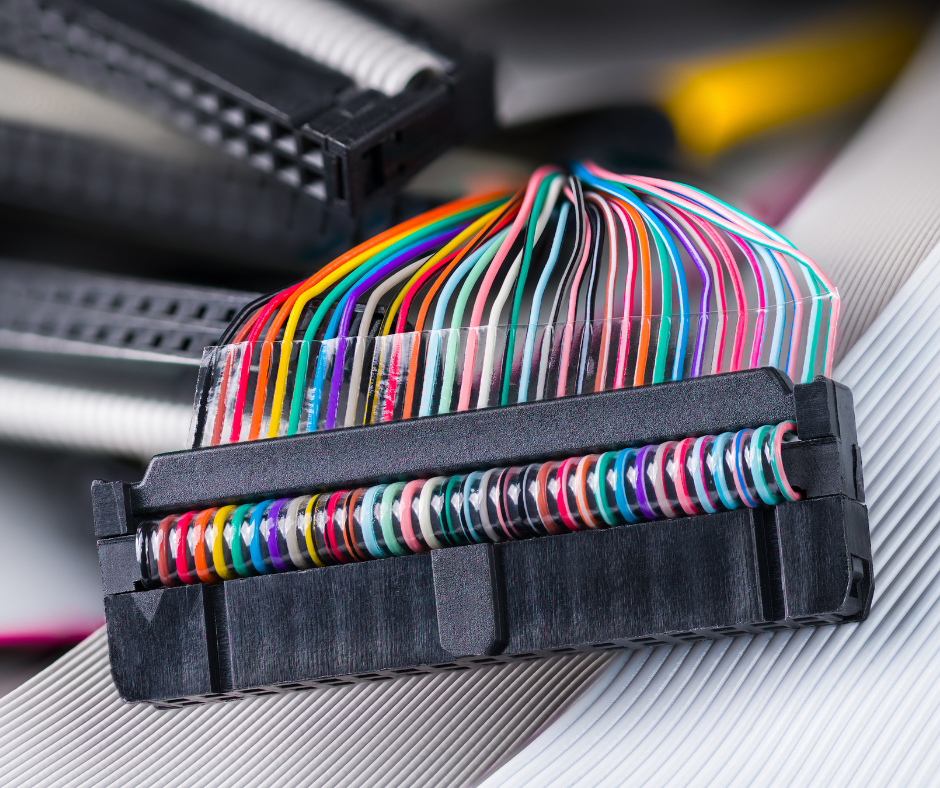
A ribbon cable, also called a flat ribbon cable or multi-wire planar cable, is a flat cable made of many insulated conductors running side by side in a single plane. Because every conductor sits at a fixed, uniform spacing (the pitch), an entire row of wires can be terminated to a connector in one press using insulation displacement (IDC) connectors. That mass termination is what makes ribbon cables fast to assemble, consistent and cost-effective.
Ribbon cables are used wherever many signals need to travel a short distance inside equipment with limited space. Their low profile lets them fold, stack and route through tight enclosures where a round multi-conductor cable would not fit.
Ribbon Cable vs. Flat Flex Cable (FFC)
Ribbon cable and flat flex cable are often confused. A ribbon cable uses individually insulated round wires bonded together side by side, and is usually terminated with IDC, crimp or solder connections. A flat flex cable (FFC) uses flat conductors laminated between layers of film and plugs into ZIF or LIF connectors on the board. If your drawing calls for FFC, see our custom flat flex cable page.
Custom Ribbon Cable Assembly Options
Every custom ribbon cable we build starts with your requirements. Tell us what your application needs and our team will source the cable and connectors and build it to your print.
Pitch and Wire Gauge
- 0.050” (1.27 mm) pitch – the industry standard, typically 28 AWG stranded conductors
- 0.025” (0.635 mm) pitch – fine-pitch cable, typically 30 AWG, for high-density configurations
- Other pitches – including 0.039” (1.0 mm), 0.100” (2.54 mm) and 0.156” (3.96 mm) for power or legacy applications
- Wire gauges from fine 30 AWG up to heavier gauges for higher current
Conductor Count
We build ribbon cable assemblies in common conductor counts such as 10, 14, 16, 20, 26, 34, 40, 50, 60, 64 and 80, and can split or strip ribbon to odd counts when your connector requires it.
Cable Types
- Gray flat ribbon cable with a red or printed edge stripe marking conductor 1
- Color-coded “rainbow” ribbon cable for easy conductor identification
- Twisted-pair flat cable (twist-and-flat) for better noise immunity on differential signals
- Shielded and jacketed ribbon cable for EMI-sensitive environments
- High-flex ribbon cable for applications with repeated motion
- Round-to-flat (round jacketed) cable that runs round outside the enclosure and flat at the termination
Connectors and Terminations
- IDC socket connectors, dual row at 2.54 mm and 2.0 mm, with or without strain relief
- D-sub IDC connectors (DB9, DB15, DB25, DB37 and more)
- Card-edge, DIP plug and transition connectors
- Crimp and solder terminations when IDC isn’t suitable, using connectors from Molex, TE Connectivity, Hirose, JST and other major brands
- Daisy-chain assemblies with multiple connectors along one cable
- Polarization keys, latching headers and locking options
Finishing Options
- Custom lengths, including tight-tolerance lengths for fixed enclosures
- Pre-formed folds and creases for clean routing
- Strain relief, adhesive backing, labels and heat shrink
- Overmolding and custom molded ends using our in-house injection molding
Color-Coded Ribbon Cable
Rainbow ribbon cable makes installation and troubleshooting easier because every conductor is identifiable at a glance. Color-coded ribbon cables follow the standard resistor color code, starting at conductor 1:
|
Conductor |
Color |
Conductor |
Color |
|
1 |
Brown |
6 |
Blue |
|
2 |
Red |
7 |
Violet |
|
3 |
Orange |
8 |
Gray |
|
4 |
Yellow |
9 |
White |
|
5 |
Green |
10 |
Black |
The sequence repeats every 10 conductors, so conductor 11 is brown again, conductor 12 is red and so on. On standard gray ribbon cable, a colored stripe or printed marking along one edge identifies conductor 1 instead. Either way, matching pin 1 of the cable to pin 1 of the connector is critical, and it’s one of the checks we verify on every assembly.
Ribbon Cable Applications
Our custom ribbon cable assemblies support OEMs in a wide range of industries, including:
- Data center and server hardware – internal board-to-board and backplane connections
- Computers and custom PCs – front-panel, storage and peripheral connections
- Industrial automation – PLCs, motion controllers, HMIs and control panels
- Telecommunications – network switches, routers and rack equipment
- Medical devices – monitoring, diagnostic and imaging equipment
- Test and measurement – instrumentation, test fixtures and data acquisition
- Printers, kiosks and consumer electronics
Our Custom Ribbon Cable Manufacturing Process
- Quote and review. Send your cable drawing, specs and any required NDAs. Our team reviews your print and flags any sourcing or design issues up front.
- Prototype. We build prototype cable assemblies so you can validate fit and function before production.
- Production. Cable is cut to length, terminated and assembled by IPC-certified technicians, supported by automated cutting, stripping and crimping equipment and automated work instructions.
- Testing and inspection. Assemblies are inspected to IPC/WHMA-A-620 and tested for continuity, shorts and correct pin-out before shipment.
- Delivery. Finished assemblies ship from Auburn, WA or our Guadalajara partners, packaged and labeled to your requirements.
Why Choose Technical Cable Applications
Since 2002, Technical Cable Applications has manufactured custom cable assemblies and wire harnesses for OEMs across North America. We produce tens of thousands of custom cables every month, and ribbon cable assemblies are built with the same quality systems as our M12, coaxial and wire harness products.
- USA and nearshore manufacturing – shorter supply chains, lower freight costs and less exposure to tariffs and geopolitical risk than overseas sourcing
- Certified quality – ISO 9001:2015, UL (US & Canada), and IPC/WHMA-A-620 Rev. E
- Flexible MOQs – prototype quantities and low-volume runs are welcome, and our nearshore partners support lower MOQs on production volumes
- One supplier for all your cables – ribbon, USB, SATA, Ethernet, coax, M12, molded cables and full wire harnesses
- Engineering support – we help with connector selection, sourcing and manufacturability before your order goes to production
Request a Quote for Custom Ribbon Cables
Ready to move your ribbon cable supply closer to home? Email your cable drawing, specifications and any required NDAs to [email protected] or fill out our online quote form. Our team will review your print and get you a quote as quickly as possible.