A coax, or coaxial, cable is an electrical cable that carries high-frequency signals, including RF for TV, cable internet, radio and GPS, as well as baseband video through a copper center conductor surrounded by an insulating layer, a metal shield and an outer jacket. All four layers share one center axis, which is where the name comes from.
Parts of a Coaxial Cable
- Center conductor: A metal center conductor, usually copper or copper-clad.
- Dielectric: Foam or solid polyethylene, or PTFE. It keeps the conductor centered, and its material and geometry set the impedance and affect loss and signal speed.
- Shield: Foil, braid or both. It acts as the return path and blocks electromagnetic interference (EMI).
- Jacket: PVC, black UV-stabilized PE for outdoor use, or FEP for high heat. In the U.S., NEC ratings include CATV/CM (general), CATVR/CMR (riser) and CATVP/CMP (plenum).
How Does a Coax Cable Work?
Coax is a transmission line. The signal travels as an electromagnetic field in the dielectric between the center conductor and the shield, so the shield keeps it contained. Signal loss, or attenuation, increases with length and frequency. Thick cable like RG-11 loses less over a long run than thin cable like RG-59, which gives up some performance for flexibility and size.
Common Types of Coaxial Cable
The designation “RG” is commonly said to come from the U.S. military’s ‘Radio Guide’ designation. Today it’s a loose label, so two RG-6 cables from different brands can perform differently. Always check the datasheet.
- RG-6 (75 Ohm): Home cable TV, internet and satellite
- RG-59 (75 Ohm): Short video and CCTV runs
- RG-58 (50 Ohm): Radio and test equipment
- RG-174 / RG-316 (50 Ohm): Thin jumpers and GPS leads. RG-316 uses PTFE for high temperatures.
- Micro coax: Very small diameters for medical probes, cameras and aerospace electronics. See micro coax assemblies.
- Twinax and triax: While these are not technically the same as coaxial cables with their additional features, they are closely related. Twinax has two inner conductors in one shield. Triax adds a second insulated shield for better isolation.
Common Coax Connectors
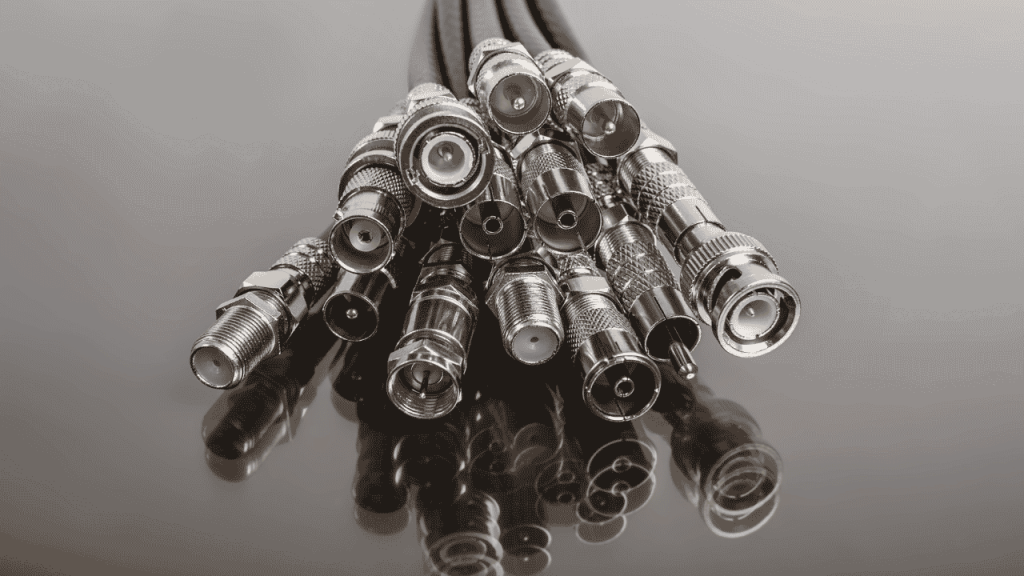
You’ll see F-type on TVs and modems, BNC on video and test equipment, N-type on antennas and base stations, and TNC, a threaded version of BNC. TNC is used when local vibrations could make a bayonet connection intermittent. RP-SMA is common on Wi-Fi and cellular antennas, while snap-on SMB, MCX and MMCX fit compact devices.
Coax vs. Ethernet vs. Fiber
Coax carries electrical signals on a shielded center conductor, twisted-pair (Ethernet) cable carries them on balanced wire pairs, and fiber carries them as light. All three can carry digital data.
One myth worth clearing up: coax isn’t capped at 10 Mbps. That number comes from 1980s coax Ethernet. DOCSIS 3.1 supports up to 10 Gbps down, and DOCSIS 4.0 raises upstream to as much as 6 Gbps.
Are All Coax Cables the Same?
No. Impedance, shielding, loss, size and jacket rating all vary. Read the jacket print (RG type, and impedance and rating where printed) then match it to your equipment. For a quick multimeter check, disconnect both ends first. Attached equipment, splitters and terminators change the readings.confirm continuity end to end on both the center conductor and the shield, and no continuity between them. Measuring RF performance takes RF test gear.
Off-the-Shelf vs. Custom Coaxial Cable Assemblies
A store-bought cable is fine for standard lengths and connectors. OEMs usually need more: exact lengths and tolerances, mixed connectors like SMA to BNC, several coax lines in one harness, micro coax terminated to a PCB, overmolded strain relief or repeatable production runs.
Technical Cable Applications has built custom coaxial and RF cable assemblies to customer drawings since 2002, from prototype through production, out of Auburn, WA. We’re ISO 9001:2015, UL certified for the United States and Canada for cable assembly, and hold to IPC/WHMA-A-620 standards. We work with businesses, not consumer installs.
Have a drawing? Send it to our coaxial cable team for a quote.