Battery Cable Assemblies
Battery Cable Assemblies
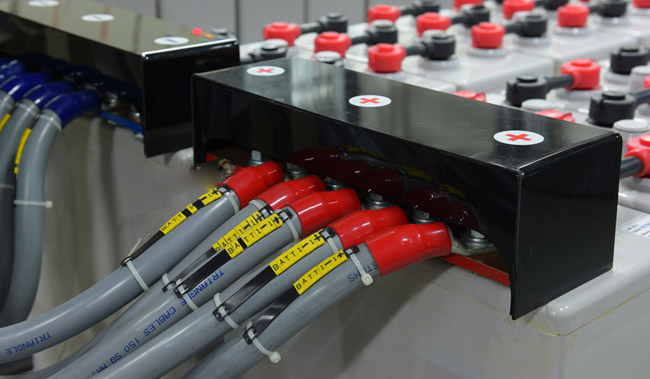
The battery is a key component in powering our new generation of automobiles. It is essential to start fuel powered vehicles, heavy equipment, fleet trucks, boats, and generators. Batteries are used as a power source in RVs, campers, motor homes, golf carts and other off grid applications and used to store energy from solar and wind turbines. One thing common to all this equipment is the need for reliable battery cable. It makes the connection from the battery to other components, and it must be reliable. Technical Cable Applications manufactures high quality battery cable assemblies for all these applications. There are some key characteristics that need to be considered when producing battery cable assemblies.
Wire Gauge
Battery cable is available in a wide choice of wire gauges to satisfy power requirements. The amount of allowable power or amperage that can be put through a cable is dependent on the application, location, and ambient temperature the cable will be exposed to. For automotive applications the SAE standard applies, and usage in homes and businesses refers to the NEC standard and local codes.
Sizing battery cable comes down to three numbers: peak amperage, total run length, and the voltage drop the circuit can tolerate. A short jumper between a battery and a nearby solenoid may carry the same current as a twenty-foot run out to a winch, but the longer run needs far more copper to keep the drop inside spec. Most starting and charging circuits land between 6 AWG and 2/0 AWG, while inverter, winch, and traction circuits usually sit at the heavy end of that range. Send us the amperage, the run length, and the ambient conditions, and we’ll get back to you with a quote.
It is also worth remembering that a conductor sized only for steady-state current can still fail a cold-crank test. Starting current is a brief, violent spike, and a run that is one gauge light can sag enough to make a healthy starter behave like a dying one. When the equipment is expensive to diagnose in the field — a fleet truck, a generator set, a rental machine — we generally recommend rounding up rather than trimming to the minimum the chart allows.
Stranding
The stranding of the wire has a huge impact on the flexibility of battery cable assemblies. For most automotive applications the flexibility of the cable is not as important because the cable will usually be in a fixed position connecting the battery to the starter or alternator, so a lower strand count is often acceptable.
There are applications where the cables need to be flexible because the connected devices need to be moved frequently or when the cable is exposed to constant bending. Then a higher strand count is needed for increased flexibility.
Strand count also changes how the wire behaves during termination. Fine-strand wire requires lugs rated specifically for fine-strand and custom dies, and fills the barrel of a lug completely, while coarse wire is stiffer to route but easier to push through conduit. Flexible welding-grade wire is the usual choice for inverter leads, marine main runs, and any route with more than a couple of tight corners in it. Tell us how the finished build has to bend and we will match the wire construction to it.
Insulation
Battery cable assemblies in automotive applications often need to withstand higher temperatures and resist exposure to the oil and chemicals found under the hood. SAE type SGT and SGX battery cable is meant for use in automotive and vehicular applications. SGT cable, insulated with PVC, is rated for use up to 105°C. SGX cable, insulated with cross-linked insulation, is much more abrasion resistant and withstands higher temperatures up to 125°C. For some applications, including solar, NEC and UL rated wire is often required and the type needed depends on whether the cable will be used in an indoor environment or in conditions where the cable will be exposed to moisture, heat, or sunlight.
Insulation color is part of how a finished build gets read on the shop floor and in the field. Red for positive and black for negative is the convention nearly everyone recognizes, but color options do not stop there. Battery cable is stocked in the required NEC color configurations and used as legally required, which makes it possible to code a multi-run system so no one has to trace a lead by hand. Printed legend, colored identification bands, and permanent labels are further options when a build will be serviced years later by someone who was not there when it was made.
Connectors, Terminals, and Lug Options
There are numerous connector types used for battery connections with the most common being the standard battery terminal that goes over a lead post and the ring lug terminal. They come in straight and right-angle configurations to fit various wire gauges. Post clamps are typically made of cast lead or lead alloys, while attached ring lugs are often made using tin-plated copper.
Beyond the post clamp, the battery ring terminal is the workhorse of the industry, and lug options run from thin stamped copper for light circuits to heavy forged and tin-plated barrels rated for high-compression hydraulic crimping. Stud sizes, barrel lengths, angles, and plating are all options that get specified on a print rather than assumed. We can supply a finished build with both ends terminated in ring lugs, one end terminated in a post clamp, or a mix of quick-disconnect, stud, and bolt-through options at either end.
Battery Cable Accessories
A finished battery cable run is rarely just copper and a lug. Accessories are what turn a bare conductor into something that survives a decade under a hood or in a bilge, and they are worth specifying up front rather than sourcing in a hurry later. The accessories we install most often include molded terminal boots, insulating covers for exposed studs, anti-corrosion washers, adhesive-lined tubing, braided sleeving, split loom, grommets, strain reliefs, and stainless hardware for marine service.
Overcurrent protection belongs on that list too. A fused battery cable protects the run itself, not only the device at the far end, and ANL, MEGA, and Class T holders each suit a different circuit. Bus bars, distribution blocks, terminal covers, and cable ties round out the accessories most builds need, and grouping those accessories with the assemblies keeps one job from arriving ninety percent complete.
Tools and Termination
The right tools matter as much as the right copper. Heavy gauge does not crimp reliably with hand tools built for signal wire; at 4 AWG and larger (2, 1, 1/0 and up) the work belongs to a hydraulic or pneumatic crimper with dies matched to both the conductor and the lug barrel. Our production floor runs calibrated tools for every size we build, and dies are checked against pull-test data rather than by eye.
Cutting tools matter as well. A clean, square cut keeps strands from splaying and keeps the barrel filled, which is what a pull test is actually measuring. Finished cable assemblies then go to electrical test, where continuity and resistance checks catch the faults no visual inspection will find.
Applications and Custom Options
Different industries push battery cable in different directions. Marine builds need tinned copper, sealed lugs, and hardware that will not weep green after a season. Solar and off-grid systems send large amounts of electrical power from the battery to the inverter at low voltage, so utilizing properly made battery cable assemblies is important to minimize power loss. Fleet and heavy equipment work is about vibration, chafe, and service access. Golf carts, floor scrubbers, and lift equipment need short, repeatable jumpers in volume, where consistency between units matters more than any single build.
Custom battery cable is where most of our work sits. Send a drawing, a sample, or a photograph of what failed, and we will quote against it. Cut length, terminal type, orientation, color, marking, protective covering, and packaging are all options you choose rather than accept. We build prototypes first, then hold the same process for production, so the assemblies in unit five hundred match the ones you approved. The same is true of a wire harness that has to merge with the run — one supplier, one print, one revision level.
Reliability – Quality Battery Cable Assemblies
Technical Cable Applications is an ISO 9001:2015 and IPC/WHMA-A-620 Rev E registered manufacturer of cable assemblies. The company is a UL certified cable assembler for wiring harnesses, US and Canada, categories ZPFW2 / ZPFW8, file E363245, with quarterly random UL audits. Highly skilled employees assure that the components are assembled correctly. Contact our Technical Cable Applications sales team for application assistance for all your cable assembly needs.
Every build ships with the documentation the job requires, and our sales group will help you compare options before anything is cut. Whether the need is a handful of cable assemblies for a prototype chassis or a standing release of cable assemblies for a production line, the process is the same: agree on the print, prove it on a sample, then repeat it. Send us your gauge, length, terminal, and accessories requirements and we will turn a quote around quickly.